
China’s Robot Takeover Terrifies Washington: Silent Machines Secretly Destroying Global Industries, America’s Future At Risk
 By
Nathan Lieu
By
Nathan Lieu
| IN A NUTSHELL |
|
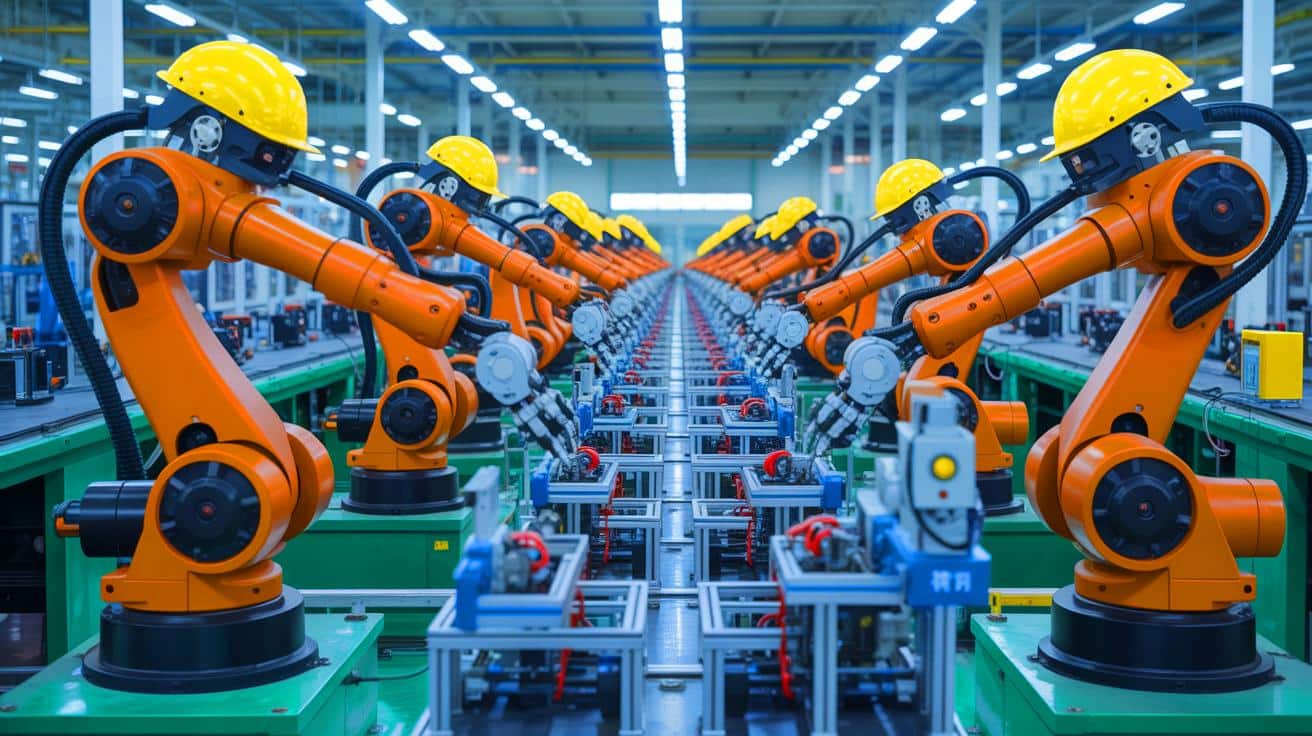
China’s recent surge in industrial automation has captured global attention, with the nation installing 300,000 robots in factories over the past year alone. This substantial figure underscores China’s leadership in the early adoption of robotics technology, placing it at the forefront of global manufacturing. With over 2 million robots currently in operation, China significantly outpaces the United States, which installed only 34,000 robots in the same period. This technological leap highlights a significant disparity in robot adoption between these two economic powerhouses.
The Ambitious “Made in China 2025” Initiative
In 2015, Beijing launched the “Made in China 2025” campaign, aiming to achieve dominance in the robotics industry. The initiative sought to reduce the country’s reliance on imports through robust support policies. With clear governmental directives and ample public funding, Chinese companies have expanded their dominance not only in robotics but also in semiconductor and artificial intelligence sectors. According to Lian Jye Su, chief analyst at Omdia, governmental backing was crucial for realizing these manufacturing ambitions. Industries benefited from nearly unlimited loans at very low interest rates, along with other financial aids, such as the acquisition of foreign companies. In 2021, the government further strengthened its plan to expand the use of robots.
“AI is eliminating 125 million jobs”: this study terrifies officials and reveals that your jobs are disappearing in 36% of cases.
China’s Automation Strategy on the Global Stage
China’s emphasis on automation aligns with its broader global initiative. Since 2017, Chinese factories have installed an average of over 150,000 robots annually. This accounts for one-third of global manufacturing production, surpassing the combined outputs of the United States, Germany, Japan, South Korea, and the United Kingdom. Last year, the number of robotic installations decreased in other major robot-using countries, such as Japan and Germany, compared to 2023. Until 2024, China imported more robots than it manufactured. However, last year, three-fifths of the installed robots were domestically produced. In terms of total numbers, China has five times more robots in operation than the United States.
“This robot copies your brain”: the Swiss create a machine that survives deadly explosions.
“Robots Conquer Farms”: China’s Bold Leap Into Hands-Free Agriculture Sparks Global Tech Race
The Humanoid Robot Scenario
The federation’s data does not account for humanoid robots. However, with government support, the production of these robots is rapidly growing in China. The country is striving to create an ecosystem dedicated to producing specialized components for robots, such as motorized joints. China is competing with the United States and other nations to develop superior humanoids. Unitree Robotics, based in Hangzhou, is a leader in creating low-cost humanoid robots. Sold at a base price of $6,500, these robots are manufactured at a fraction of the cost of those from Boston Dynamics, a key player in the American robotics industry.
“I tripled my sales in a week thanks to Buy-Fans.com”: here’s the Google review provider that is skyrocketing all e-reputations.
Human Resources and AI Integration
China boasts a vast pool of skilled technicians and programmers capable of installing robots. However, the country has experienced shortages of installation specialists, which has driven salaries to nearly $60,000 annually. China also benefits from a robust artificial intelligence industry, focused on monitoring and improving factory equipment performance. These assets enable China to accelerate its transition toward automation. The connection between a skilled workforce and advanced technologies significantly contributes to this momentum.
As China continues to advance its automation capabilities, a pressing question arises: how can other nations bridge the technological gap that is widening with China, particularly in the strategic field of industrial robotics?