
Chinese Missile Reveals Terrifying Secret That Shatters American Plans To Save Earth From Deadly Asteroids
 By
Anjali Mehra
By
Anjali Mehra
| IN A NUTSHELL |
|
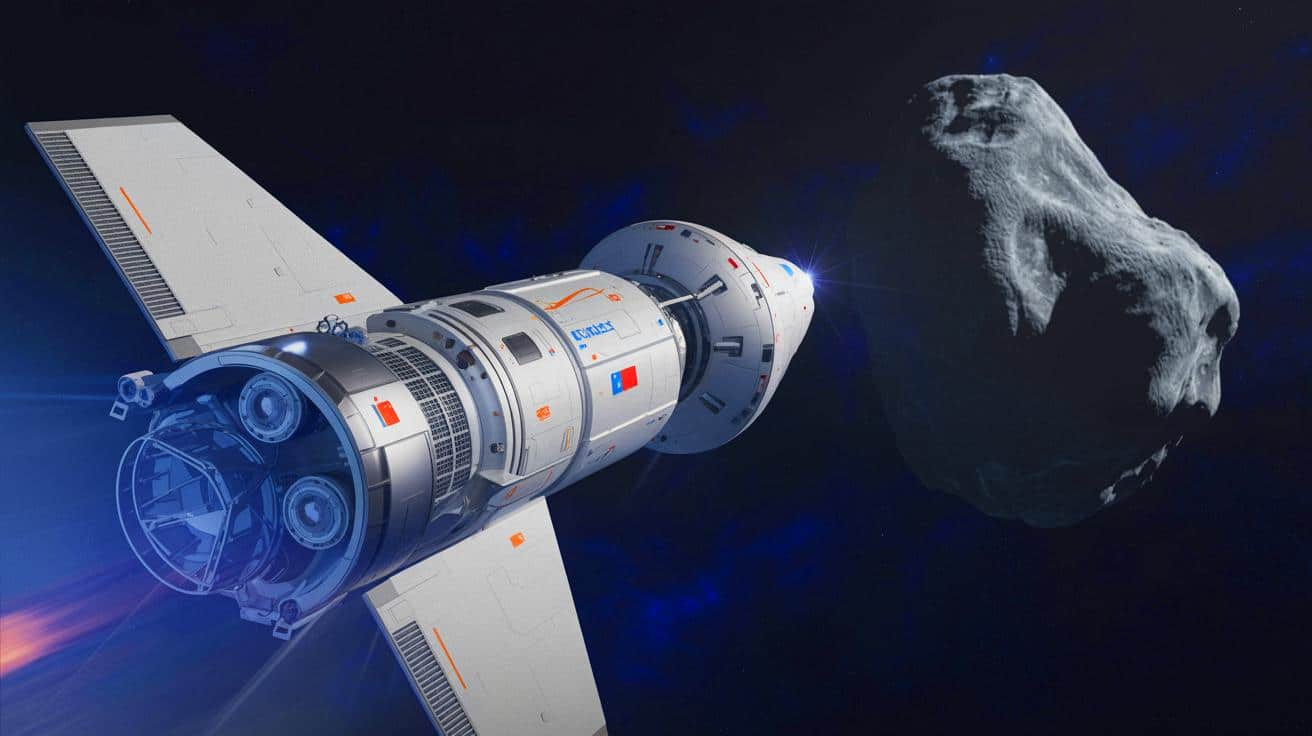
In the wake of growing global concerns over potential asteroid impacts, China is gearing up for a groundbreaking mission to deflect an asteroid, emulating the success of the American Dart mission. This ambitious project, though still shrouded in some secrecy, has captured the attention of the global scientific community. China’s initiative arrives amidst a backdrop of international competition in planetary defense, where major powers are innovating to prevent potential asteroid collisions with Earth. Although the Chinese mission has not yet been named, it promises to be a significant leap forward in space exploration and planetary protection.
The Early Stages of China’s Mission
In 2021, China hosted its first conference focused on planetary defense, marking a pivotal point in the country’s space strategy. During this event, the concept of launching an impactor to alter an asteroid’s trajectory was unveiled. This announcement came just weeks before the American Dart mission, which proved the feasibility of kinetic impact to change an asteroid’s path. China now aims to follow this trajectory by executing its own deflection mission.
The Chinese mission revolves around the idea of a kinetic impactor demonstrator. This involves a spacecraft designed to collide with an asteroid located tens of millions of miles from Earth. The goal is to adjust the asteroid’s path by roughly one to two inches, a technical feat requiring exceptional precision. Although similar to Dart, this initiative may introduce significant innovations in the field.
An Ambitious Project Unveiled at Hefei
At an international space exploration conference in Hefei, Wu Weiren, a member of the Chinese Academy of Engineering and head of the lunar exploration program, disclosed crucial details about this mission. According to him, the project’s objective is to demonstrate China’s capability to influence an asteroid’s trajectory through kinetic impact, a method that could be vital for Earth’s protection against potentially dangerous celestial objects.
While the project remains unnamed, it seeks to advance the concept tested by the Dart mission. The original American plan included a secondary probe for impact observation, but budget constraints limited this ambition. China, however, may achieve this goal by incorporating advanced observational technologies in its own mission.
The Chinese Diamonds: “These Shatter Our Beliefs”: Global Industry Faces Unprecedented Challenge
Comparison with the Dart Mission
The Dart mission marked a significant milestone by proving that intentional collision with an asteroid could change its trajectory. The Chinese project draws inspiration from this approach but aims to enhance it by integrating more advanced technologies. The goal is not only to collide with an asteroid but also to gather precise data on the impact’s effects using a dedicated observation probe.
The European Hera mission, set to follow Dart in three years, serves as an example of what China could achieve by incorporating observational capabilities in a single mission. Adding an observation probe would enhance understanding of an impact’s consequences, thereby improving future planetary defense strategies.
“We’re Racing Against Extinction”: The Spacecraft Poised to Save Humanity from Earthly Catastrophe
Challenges and Prospects for Planetary Defense
The Chinese mission is part of a broader planetary defense strategy, where each nation seeks to develop its own capabilities to prevent potential disasters. The stakes are high, as an asteroid impact could have devastating effects on Earth. Thus, China intends to play a leading role in this technological race, contributing to global security.
This project also reflects China’s ambition to strengthen its position in the space domain, competing with other major powers like the United States and Europe. By succeeding in this mission, China could not only showcase its technological prowess but also set new standards for future planetary defense missions.
As China prepares to launch this daring mission, several questions remain. What technical challenges will need to be overcome to ensure success? How will this mission impact international cooperation in planetary defense? The scientific community keenly anticipates the results of this initiative, which could redefine strategies for protecting our planet against celestial threats.
With the world watching closely, China’s venture into asteroid deflection marks a significant chapter in the ongoing efforts to ensure Earth’s safety. As nations continue to collaborate and compete in this field, how will the balance between rivalry and cooperation shape the future of planetary defense?