Chinese Missile That ‘Terrorizes Washington’ Can Hit Any City Worldwide, Dividing NATO With Its 10 Nuclear Warheads
 By
Daniel Okada
By
Daniel Okada
| IN A NUTSHELL |
|
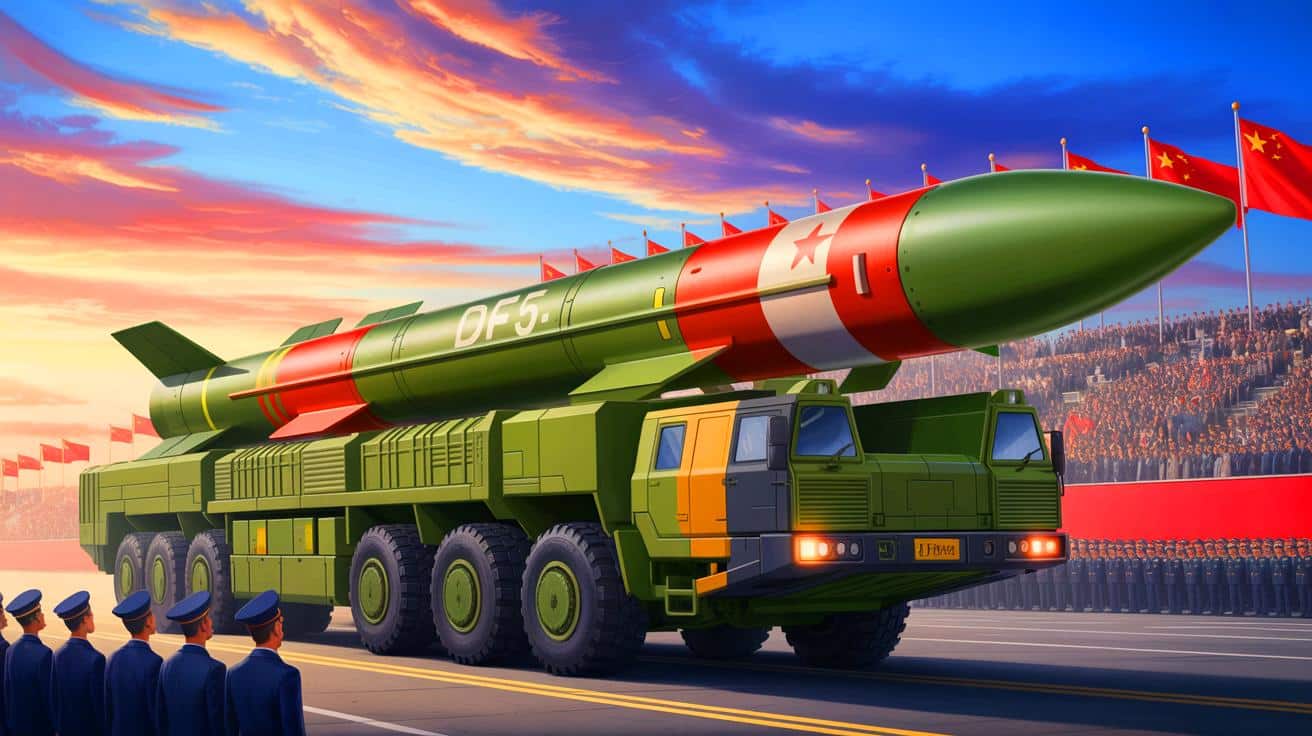
The recent military parade in China showcased the DF-5C, an intercontinental nuclear missile that underscores the nation’s growing military prowess. This event gathered global leaders and enabled China to demonstrate its ability to protect its global interests. The unveiling of the DF-5C, capable of hitting targets over 12,400 miles away, highlights China’s determination to maintain a strong strategic position on the international stage. In this context, the DF-5C symbolizes both a technological feat and a potent political message to allies and adversaries alike.
Innovative Features of the DF-5C
The DF-5C missile distinguishes itself with several advanced technical features. Its new structure allows for transport in three distinct sections, expediting launch preparations compared to previous models. This logistical flexibility is a significant advantage for rapid threat responses. Furthermore, the missile boasts an extended range exceeding 12,400 miles, ensuring a global strike capability. It can be launched via multiple methods, drawing on experience from earlier DF missile iterations. With flight speeds reaching several Mach, the DF-5C significantly reduces the reaction time of adversary defense systems.
A critical component is its ability to carry multiple independently targetable reentry vehicles (MIRV), which can be equipped with nuclear or conventional warheads, or even decoys. This capability complicates interception efforts by defense systems. Additionally, the DF-5C’s advanced guidance system, combining technologies like inertial guidance and Beidou navigation, ensures enhanced precision, comparable to that of medium or short-range missiles.
Strategic Role and Global Message
The strategic role of the DF-5C aligns with China’s nuclear deterrence doctrine, emphasizing defense. The nation upholds a no-first-use policy and refrains from targeting non-nuclear states. The military show of strength during the parade delivers a clear message about the credibility of China’s strategic deterrence. The missile’s capacity to carry up to ten warheads allows for simultaneous targeting of multiple locations, reinforcing its nuclear deterrence strategy. This ensures effective retaliatory strikes even under extreme warfare conditions. This display of power reminds the world of China’s complex security environment and its continually evolving military strength.
Other Advanced Weapons Featured
In addition to the DF-5C, the parade featured other nuclear missiles such as the JL-1 and JL-3, illustrating China’s land, sea, and air nuclear triad. The event also revealed advancements in naval aviation with aircraft like the J-35, a stealth carrier-based fighter, and the J-15T. Aerial formations included the H-6J bomber, equipped with supersonic anti-ship missiles YJ-12. New drones integrating artificial intelligence were also showcased, highlighting autonomous swarming reconnaissance and attack capabilities.
This military demonstration was not only technological but also symbolic. The presence of leaders like Vladimir Putin and Kim Jong-un prompted international reactions, particularly from the United States, underscoring the geopolitical implications of the event.
Geopolitical Implications and Future Outlook
The display of the DF-5C and other advanced weapons at the parade carries significant geopolitical implications. It demonstrates China’s intent to assert itself on the global stage as a major military power. This technological advancement strengthens China’s position against its strategic rivals while influencing regional and global security dynamics. The issue of nuclear deterrence takes on new dimensions with the evolution of Chinese military capabilities. Alliances and international relations could be affected by the perception of this rising power. How will other nations adjust their defense policies in response to these advancements? The Beijing parade poses questions about strategic balance in the coming years.
China’s military parade highlights several questions about the global balance of power. The nation’s technological and military rise has geopolitical repercussions that could redefine alliances and international strategies. How will nations worldwide respond to this assertion of power? What impact will it have on long-term global stability and security?