
Chinese Drone Terrorizes Skies: ‘Revolutionizing Military Defense’ and Threatening Traditional Aviation Within Days
 By
Nathan Lieu
By
Nathan Lieu
| IN A NUTSHELL |
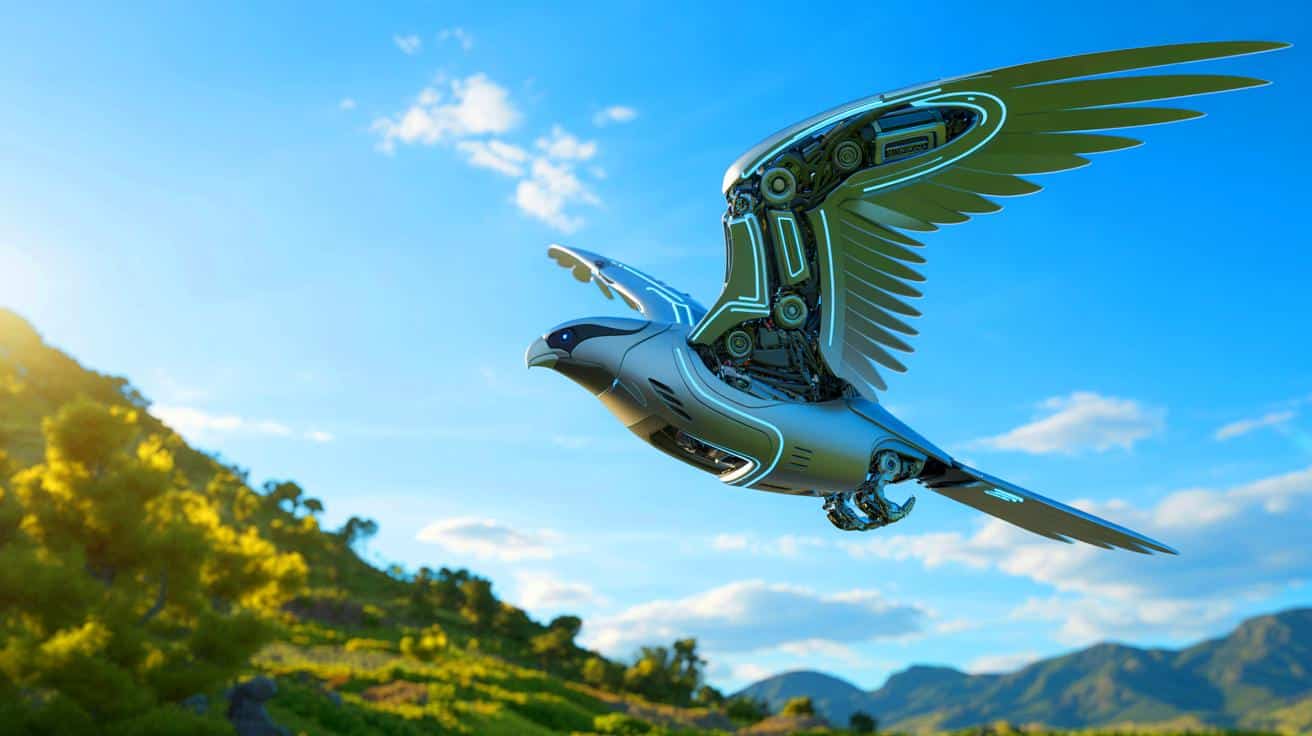
The intersection of robotics and nature-inspired design is ushering in a new era in aviation. A team of scientists in China has developed a prototype flying robot named RoboFalcon2.0, which mimics the movements of falcons. This robot employs a novel technique of wing flapping, sweeping, and folding for autonomous takeoff, presenting promising advancements in bio-inspired flight. This development enhances our understanding of avian flight mechanisms and could revolutionize biology-inspired aviation.
A Major Technological Breakthrough
The RoboFalcon2.0 features an innovative system of reconfigurable wings. This system incorporates mechanical decouplers and a lightweight structure, enabling the robot to perform wing movements in a coordinated rhythm. This capability, previously challenging to achieve for bird-sized robots, is crucial for imitating the natural flight of birds like geese and kingfishers.
Weighing only 1.76 pounds and with a wingspan of 3.9 feet, the RoboFalcon2.0 captures the dynamics of small birds while remaining robust enough for controlled experiments. Although energy consumption increases during takeoff, this model perfectly mimics the high metabolic cost of takeoff observed in living birds.
The ability to sweep the wings up to 25 degrees allows for fine-tuning the robot’s aerodynamic center, thus enhancing control during takeoff.
Challenges and Prospects for Autonomous Flight
Field tests have revealed both the potential and limitations of the RoboFalcon2.0. While it can smoothly take off and maintain low-speed flight, it experiences challenges in stabilizing its pitch as speed increases. The absence of an elevator limits its control authority in fast flight, a challenge the research team aims to address in future versions.
However, the achievement remains significant. Most flapping-wing robots rely on external launching mechanisms or insect-inspired flight movements. The RoboFalcon2.0 demonstrates for the first time an autonomous takeoff on a bird scale, replicating the biomechanics of real vertebrates.
Potential applications include surveillance, environmental monitoring, and defense, where vertical lift, quiet operation, and low-speed agility are valuable assets.
Implications for Bio-Inspired Aviation
Though still experimental, the RoboFalcon2.0 represents a significant step toward creating flying machines that truly mimic nature. Unlike rotor drones, these bird-inspired machines could combine efficiency and discretion, navigating more naturally through turbulent conditions.
The ability of these robots to integrate into natural environments while remaining efficient paves the way for new applications across various sectors. Researchers hope these innovations will lead to the design of devices that not only fly but fly as nature intended.
The research on the RoboFalcon2.0 has been published in the journal Science Advances.
Toward a New Era in Aviation
The development of the RoboFalcon2.0 marks a crucial step in understanding and replicating avian flight mechanisms. By faithfully reproducing the subtle wing movements of birds, researchers are paving the way for more efficient and environmentally friendly flying machines. The advances made in this field could transform not only the aviation sector but also influence other industries requiring innovative solutions for aerial mobility.
As researchers continue to refine this technology, an open question remains: how will these innovations impact the future of aviation, and what challenges must still be overcome to achieve fully autonomous and bio-inspired flight?