
Tesla’s New Gravity-Defying Technology Stuns Industry: “This Changes Everything,” Says Leading Automotive Engineer
 By
Nathan Lieu
By
Nathan Lieu
| IN A NUTSHELL |
|
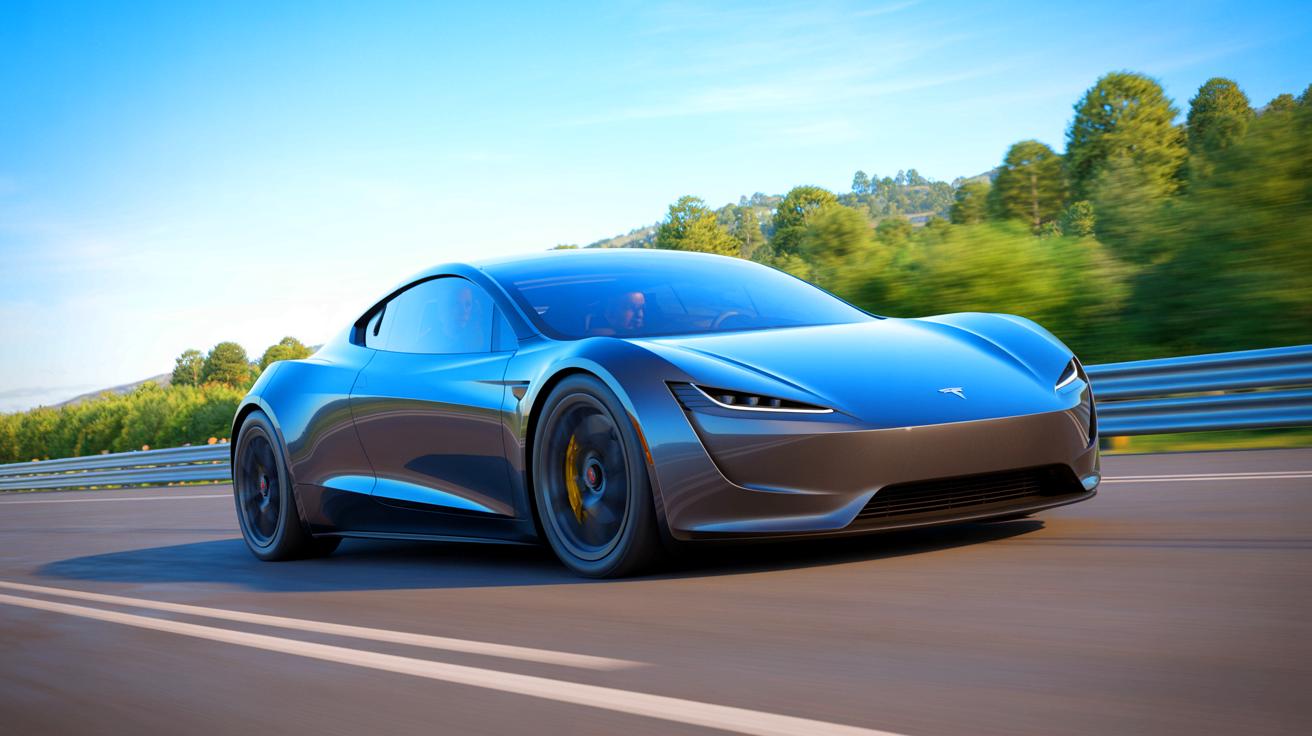
Tesla’s new Roadster is poised to redefine the limits of automotive performance. Elon Musk has long promised groundbreaking acceleration capabilities, and recent developments suggest that this ambitious vision might soon become a reality. A newly revealed patent indicates that Tesla has developed a revolutionary adhesion technology, potentially enabling the Roadster to accelerate from 0 to 60 mph in under one second. This innovation could not only transform the performance of vehicles on the track and road but also set a new benchmark for the automotive industry as a whole.
An Ambitious Vision Driven by Elon Musk
When Tesla first unveiled the Roadster, the goal was clear: achieve 60 mph in 1.9 seconds. At the time, this was a remarkable feat for a production car. However, as technology evolved, so did the competition. Vehicles like the Tesla Model S Plaid have since narrowed this gap, prompting Musk to revise the Roadster’s design objectives. By February 2024, the aim was set to break the symbolic one-second barrier, a performance previously reserved for Top Fuel dragsters.
Achieving such speed presents significant challenges, primarily concerning traction. In acceleration races, maximizing traction is crucial to harnessing the power of electric motors. For Tesla, overcoming traditional physical constraints requires radical technological innovation and a shift in automotive design paradigms.
The Physical Challenges of Adhesion
The primary obstacle to achieving such extreme performance is traction. Even with a colossal engine power, performance is limited without proper adhesion. Racing cars use aerodynamic elements to generate downforce, but these solutions are ineffective at low speeds, leaving weight as the main contact factor at launch. Tesla’s innovative approach has found a way around this limitation.
The patent filed by Tesla proposes an unprecedented solution, significantly increasing traction. This innovation could indeed turn the Roadster into a true acceleration beast. The technology employs a mechanism that generates artificial attraction force, enhancing vehicle adhesion from a standstill. This could be the key to achieving the under-one-second 0 to 60 mph goal.
A Technology Inspired by Ground Effect
The patented technology draws inspiration from the ground effect but innovates in its application. The concept includes fans integrated into the chassis and deployable skirts under the vehicle. These elements create sealed compartments, and the fans extract air from these areas, generating a vacuum that “pulls” the car toward the ground. This attraction force enhances traction without needing prior speed.
Unlike traditional aerodynamic solutions, this system functions even when stationary. The downforce is instantaneous and adjustable as needed. Thus, the Roadster could benefit from optimal adhesion at any time. This approach might revolutionize how performance vehicles are designed, potentially rendering traditional aerodynamic and brute force methods obsolete.
Potential Beyond Acceleration
The technology Tesla has developed extends beyond mere acceleration. It could also transform the Roadster’s handling. In turns, the additional downforce would allow for maintaining high speeds. On tracks, this technology would provide a significant advantage, enabling Tesla to target records on famous circuits. The system’s modular aspect is another advantage, with deployable skirts used only when necessary, preserving aerodynamics during everyday use.
If Tesla manages to industrialize this technology, the Roadster could redefine automotive performance standards. Achieving 0 to 60 mph in under one second would place the Roadster in a class of its own, potentially marking the beginning of a new era where traction is a controllable variable. This innovation could reshape consumer expectations and redefine automotive performance.
Tesla’s patented technology opens the door to new possibilities in the automotive industry. Should this innovation come to fruition, it could revolutionize current standards. However, several questions remain. How will this technology be integrated into mass production? What will be its impacts on safety and energy efficiency? Will the answers to these questions determine the future of automotive innovation?