“We’re Racing Against Extinction”: The Spacecraft Poised to Save Humanity from Earthly Catastrophe
 By
Anjali Mehra
By
Anjali Mehra
| IN A NUTSHELL |
|
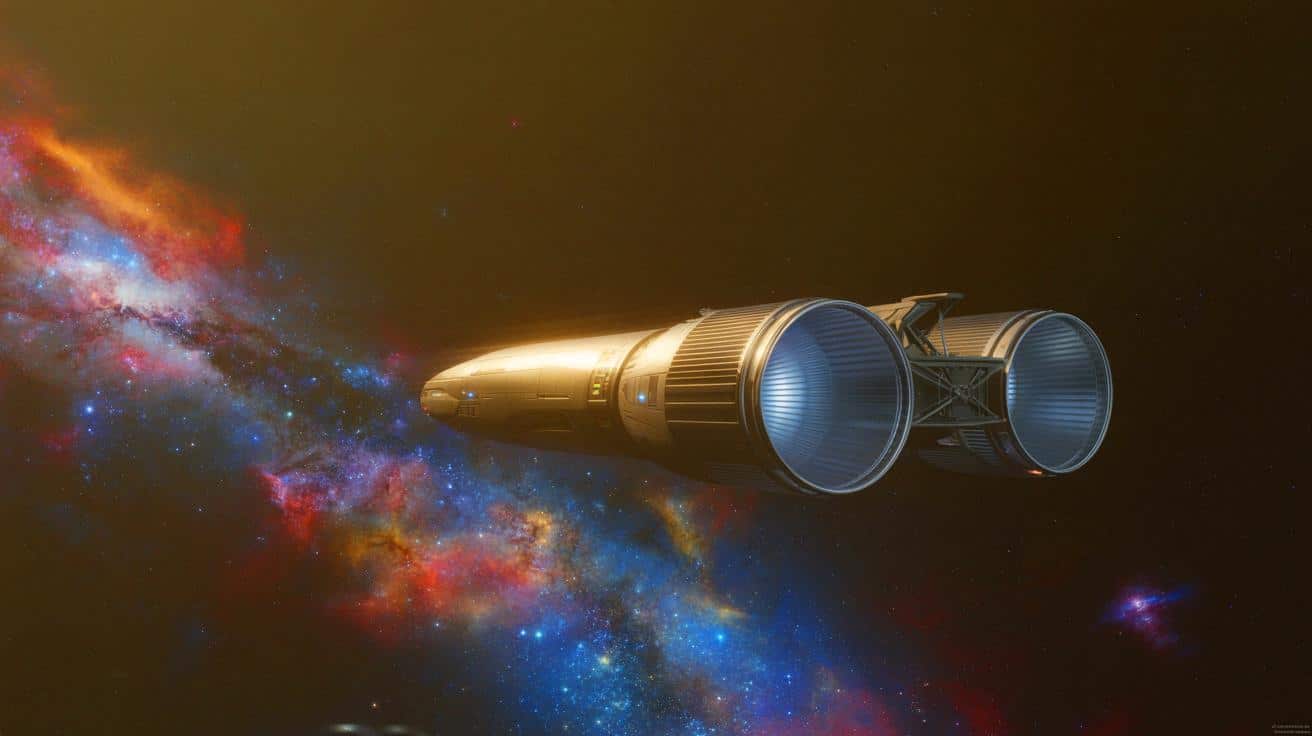
The pursuit of human space exploration has taken a significant leap forward with the unveiling of the Chrysalis project. Designed for a journey to Proxima b, a potentially habitable exoplanet located 4.24 light-years from Earth, this spacecraft concept has captivated scientists and dreamers alike. An international competition challenged innovators to conceptualize a vessel capable of undertaking this audacious expedition. Chrysalis, the winning design, promises to transport travelers at an unprecedented speed. As we delve into the intricacies of this project, we must ask: What makes such a feat conceivable, and which cutting-edge technologies could turn this dream into a reality?
The Challenge of Designing Chrysalis
Envisioning a spacecraft capable of traversing the vastness of space demands extraordinary ingenuity. Participants in the Hyperion Project competition were tasked with designing a vessel that could accommodate and sustain approximately one thousand people over a 250-year journey. The concept of Chrysalis centers around creating a self-sustaining environment that ensures the survival of its passengers. Italian researchers contributed solutions for managing gravity, food supply, and waste, while also focusing on preserving knowledge and culture across generations.
The engine of the Chrysalis would employ the nuclear fusion of helium and deuterium isotopes to propel the ship at one-tenth the speed of light. This technology would also provide the necessary electricity for its inhabitants. The project underscores the importance of international collaboration and scientific research in pushing the boundaries of human exploration.
Between Science-Fiction and Reality
Chrysalis, with its structure inspired by world ships of science-fiction lore, embodies the intersection of imagination and feasibility. Its cylindrical shape and length of approximately 190,000 feet make it a true space chrysalis. This design, borrowed from the works of Isaac Asimov, aims to minimize the risk of impacts with micrometeorites and space debris. The narrower front of the vessel would rotate to create artificial gravity, making life onboard more akin to life on Earth.
Inside Chrysalis, a fully functioning ecosystem would exist, with dedicated spaces for housing, culture, and agriculture. Passengers would have the opportunity to marvel at the universe from specially designed observatories. While this project may seem far beyond our current technological reach, it is a reminder that humanity has always been driven to explore what once seemed impossible.
Scientific and Technical Implications
The design of Chrysalis raises crucial questions about the technologies required for interstellar travel. While theoretical, nuclear fusion propulsion represents a step toward the future of space exploration. This method could provide a sustainable and efficient solution for long journeys through the cosmos. Furthermore, managing resources aboard the vessel, such as water, air, and food, is essential for ensuring the long-term survival of its passengers.
Another fundamental aspect is the resilience of the spacecraft against the challenges of space. The structure must withstand cosmic radiation and extreme temperature variations, necessitating advanced materials and innovative protection systems. Chrysalis presents a unique opportunity to explore and develop these technologies for future missions.
Toward a New Era of Exploration
The Chrysalis project is part of a broader vision of humanity’s future in space. As Earth’s resources dwindle and the global population grows, the search for new frontiers becomes imperative. Exoplanets like Proxima b offer a glimpse into the habitability beyond our solar system, yet setting foot on another planet remains a colossal challenge.
The scientific and technological advancements required to realize this dream inspire unprecedented collaboration between nations. They also encourage a new generation of researchers and engineers to push the limits of what is possible. Chrysalis symbolizes a step toward understanding and conquering interstellar space.
While Chrysalis remains an ambitious and theoretical project, it stimulates reflection on our future in space. How might these innovations be implemented to transform science fiction into reality? The question remains open, inviting us to continue the pursuit of knowledge and exploration.