
New Military Cargo Plane Terrifies Pentagon, Shattering Logistics With Massive 6,800 Cubic Meters Capacity
 By
Nathan Lieu
By
Nathan Lieu
| IN A NUTSHELL |
|
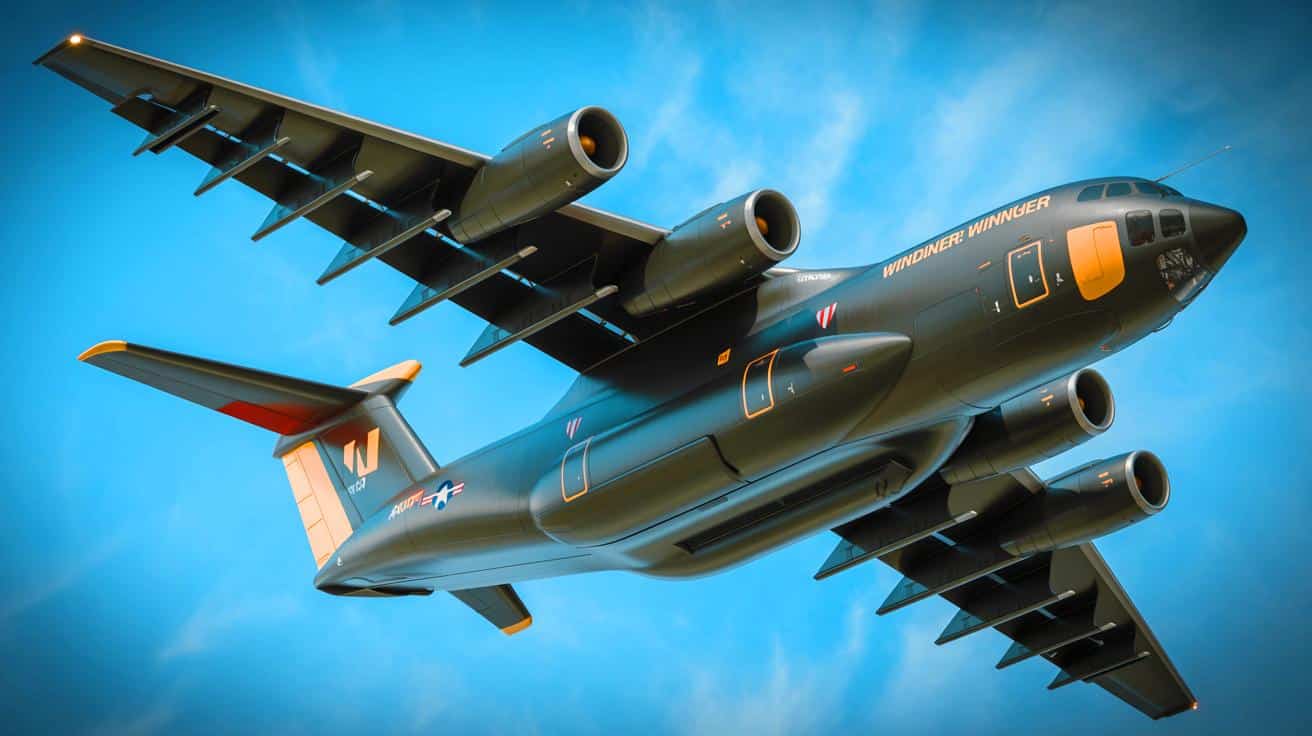
The WindRunner, a groundbreaking aerospace innovation, has the potential to reshape military logistics significantly. Developed by the American company Radia, this colossal aircraft is designed to transport entire squadrons without the need for disassembly. With a cargo capacity surpassing all current models, the WindRunner promises to enhance strategic deployments in challenging environments. Scheduled for its first flight by 2030, the aircraft stands out for its ability to operate on unprepared airstrips, offering a solution to modern military logistical challenges. The implications of this development on future military operations remain profound and multifaceted.
Reimagining Military Logistics
The WindRunner sets itself apart by enabling the transport of complete systems, such as helicopters and fighter jets, ready for deployment without prior disassembly. Its cargo capacity of 240,000 cubic feet far exceeds that of existing aircraft like the C-5 Galaxy or the C-17 Globemaster III. This design shift emphasizes operational flexibility over maximum carry weight, aiming to deploy forces swiftly even in areas with compromised infrastructure.
Mark Lundstrom, the founder and CEO of Radia, emphasizes the importance of moving ready-to-use systems. This approach could reduce reliance on additional equipment, such as in-flight refueling or runway preparation. Such innovation aligns with Agile Combat Employment (ACE) strategies, which focus on the rapid dispersion of forces and equipment, particularly in the Indo-Pacific region.
Strategic Advantages in Contested Zones
The WindRunner is engineered for operations from unprepared airstrips measuring 5,900 feet, a critical capability for advanced operations in degraded environments caused by natural disasters or conflicts. In comparison, the C-5 requires at least an 8,000-foot runway for a fully loaded landing. This advancement marks a significant leap for armed forces needing to respond swiftly in areas where infrastructure has been severely impacted.
The demand for a solution like the WindRunner is heightened by the aging fleet of existing aircraft, such as the C-5 and the An-124, whose production ceased decades ago. Radia’s focus on rapid, intact delivery of large cargo is crucial in future scenarios involving peer adversaries. This flexibility is especially vital for humanitarian missions or the rapid deployment of mobile hospitals.
An Ambitious Timeline and Industry Skepticism
Radia aims for the WindRunner’s maiden flight by 2030, utilizing certified components and proven aerospace technologies to expedite development. However, industry observers remain skeptical about the financial and technical challenges that lie ahead. The lack of new strategic transport aircraft in the West since the C-17 highlights the project’s ambitious nature. If successful, the WindRunner could herald a paradigm shift in military transport.
The company has already forged five key partnerships to bolster its supply chain and is collaborating with the U.S. Department of Defense to explore the WindRunner’s potential in both civilian and military applications. Despite these advancements, questions linger regarding funding, certification hurdles, and the adoption of a platform that prioritizes volume over raw power by military planners.
Challenges and Future Prospects
The WindRunner’s success will hinge on its ability to convince military decision-makers of its unique advantages. As warfare evolves toward more dispersed and technologically advanced forms, this type of transport could become indispensable. However, challenges abound, from financing and certification to institutional acceptance. The WindRunner represents a bold gamble on the future of military operations.
The question remains: as military needs evolve, will the WindRunner establish itself as the linchpin of modern logistical operations?
As military technologies advance, the WindRunner poses a pivotal question: can it redefine logistics to meet the demands of future conflicts effectively?