
China’s Secret Tech Reveals Hidden Mineral Scandal That Terrifies The World And Leaves The West Powerless
 By
Nathan Lieu
By
Nathan Lieu
| IN A NUTSHELL |
|
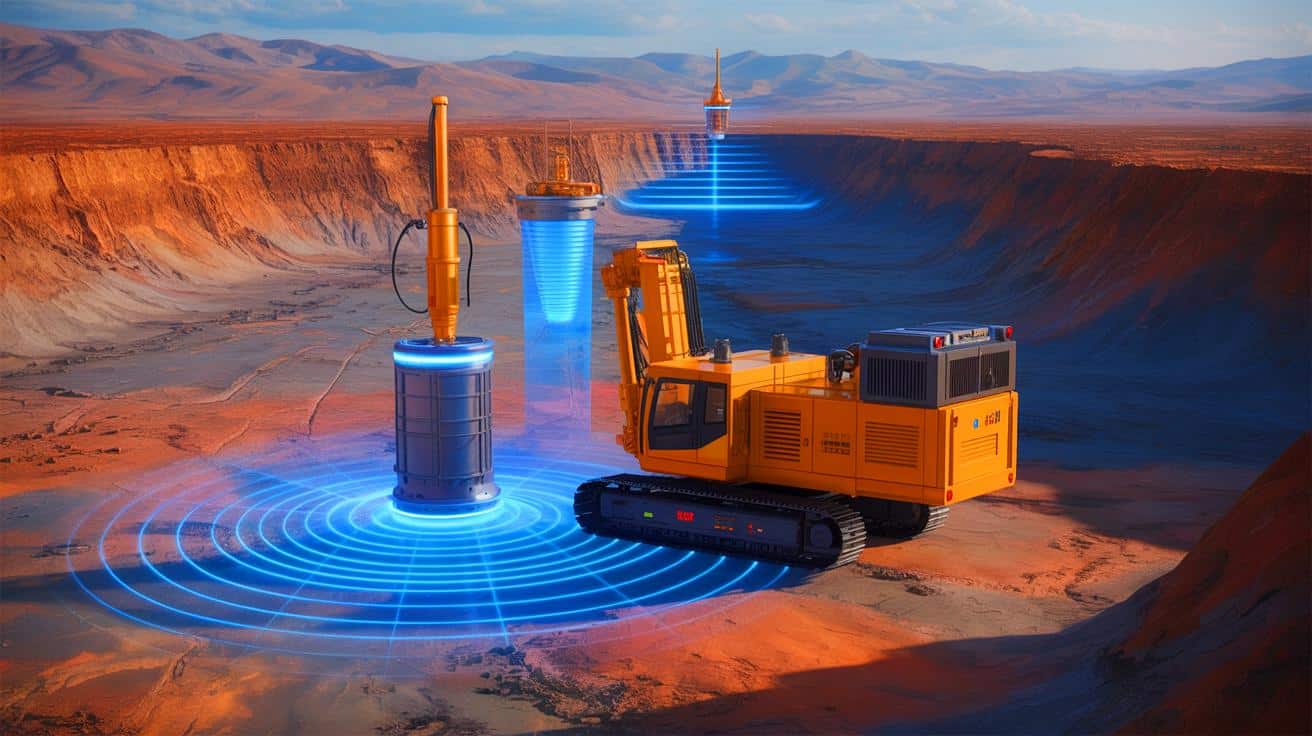
The global race for critical mineral resources has intensified, driven by the demand for technologies that support sustainable development. Amidst this competition, China has surged ahead by deploying advanced electromagnetic technologies for deep mineral exploration. These groundbreaking systems, capable of probing deep beneath the Earth’s surface, are revolutionizing the way geologists locate essential mineral deposits such as lithium, cobalt, and rare earth elements. As the appetite for these resources grows, China’s ability to harness these technological advancements may redefine the global landscape of mineral exploration.
China’s Technological Edge Over the West
China has established itself as a leader in electromagnetic exploration, a fact underscored by a recent study from the China Geological Survey (CGS). The study highlights China’s use of high-power tools that exceed 100 kilowatts, a threshold the United States has yet to reach, with its most powerful equipment topping out at 30 kilowatts. This technological edge has enabled China to make significant discoveries, such as the world’s largest gold deposit and substantial lithium reserves. The CGS asserts that these high-powered systems are pushing the boundaries of exploration depth, setting new industry standards.
China’s advancements in electromagnetic exploration tools extend beyond mere technological superiority. They represent a strategic advantage in the global race for critical minerals. As these systems redefine exploration capabilities, China continues to secure its position at the forefront of mineral resource discovery.
The Massive Aircraft: “It’s a Giant Leap Forward” for Delivering Wind Turbines to Remote Areas
Mapping the “Second Mineral Space”
With traditional mining exploration techniques reaching their limits, China is turning its attention to the “second mineral space.” This term refers to the deep layers of the Earth’s crust, located between 1,640 and 6,560 feet below the surface, where mineral signals are weak and often obscured by ambient noise. To overcome this challenge, China employs transmitters exceeding 100 kilowatts, capable of penetrating these depths. At the Jiama copper mine in Tibet, this technology has mapped underground structures more than 9,840 feet deep, surpassing conventional methods in both precision and depth.
The exploration of this “second mineral space” not only uncovers hidden resources but also redefines the potential for future discoveries. China’s ability to explore these depths with unparalleled accuracy sets a new benchmark for the industry. As other nations strive to keep pace, the question remains: can they match China’s expertise in deep mineral exploration?
The Wireless Electromagnetic Method
The Wireless Electromagnetic Method (WEM) is one of China’s most ambitious projects. This system utilizes two antenna lines, one measuring 50 miles and the other 75 miles, to transmit signals over long distances. Initially designed for naval communication, the WEM has evolved into a revolutionary tool for resource exploration. In a national test conducted in 2023, its signals were detected across Tibet, Inner Mongolia, and Guangdong, covering distances exceeding 1,240 miles. The results demonstrated unprecedented efficiency in detecting underground magnetic fields.
The versatility of the WEM technology highlights its potential to transform resource exploration. By adapting a system initially intended for military use, China has not only expanded its technological capabilities but also enhanced its strategic position in the global resource competition. As the world seeks new ways to access critical minerals, the WEM stands as a testament to China’s innovative approach.
Global Competition for Mineral Resources
With these technological advancements, China has positioned itself at the forefront of the global race for critical mineral resources. Researchers from the CGS note that, aside from Russia, Western nations rarely use high-power electromagnetic instruments for terrestrial exploration. By controlling this technology, China strengthens its position in the international competition for essential resources. As the world transitions to renewable energy, the ability to discover and secure resources like lithium and cobalt could determine which countries lead the next industrial era.
The strategic significance of China’s advancements in mineral exploration cannot be overstated. As nations strive to meet the growing demand for critical resources, the question arises: can they develop the technologies necessary to compete with China’s innovative approach to resource discovery?
China’s exploitation of ultra-powerful electromagnetic systems for mineral exploration represents a significant strategic advantage. As global demand for critical mineral resources continues to rise, the question remains: will other nations be able to catch up and compete with China in this technological and mineral quest?